
Polysynchrony
Self-awareness is rarely the result of a single realization. Instead, it emerges through the recognition of countless interconnected forces that shape who we are. Some are instinctive, others learned. Some unite us, while others divide us. Together, they form a complex web of influences that is constantly evolving.
This is a concept album exploring that web of interconnected ideas. Each composition examines a different aspect of the human experience—from reflex and origin to discord, perfection, pretense, and truth. The title, borrowed from the album's second track, represents the realization that none of these exist in isolation. Every thought, action, belief, and relationship exists in synchrony with countless others, continually shaping the person we become.
Rather than offering conclusions, it invites listeners to explore these ideas for themselves and to reflect on the rhythms, connections, and contradictions that define the journey toward self-awareness.
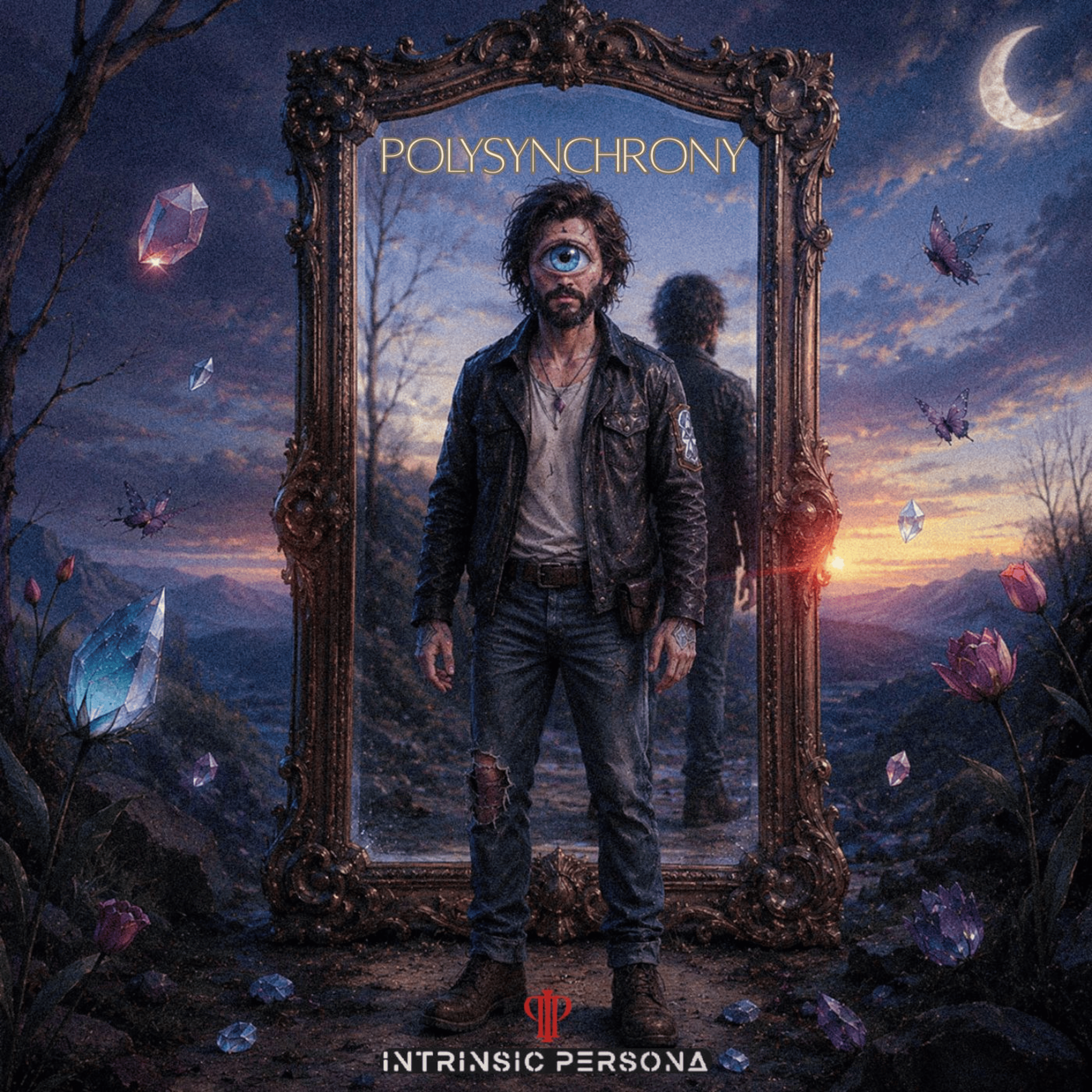
Polysynchrony - © 2026
Artwork by Adam’s Gallery
Automatism
Concept: Reflex
The Question
How much of who we are is the result of conscious choice, and how much is simply reflex?
The Spark
Unlike many of the pieces on Polysynchrony, Automatism wasn't born from a specific event or philosophical idea. The music came first. As the composition took shape, it became clear that it was expressing something instinctive—something that felt automatic rather than deliberate.
Searching for a word that captured that feeling eventually led me to automatism: actions performed without conscious thought. It immediately resonated with the piece, not because it inspired the music, but because it described what the music had already become.
In many ways, Automatism set the stage for the entire album. It was the first glimpse of a larger exploration into the unseen forces that shape our thoughts, behaviors, and ultimately, our sense of self.
The Journey
Automatism serves as the overture to Polysynchrony, introducing many of the musical ideas that will reappear throughout the album. It begins with an atmospheric synth and a delicate plucked melody, quietly presenting the central motif that connects the entire work. Rather than announcing itself with force, the album opens with something understated, suggesting that the patterns shaping our lives often exist just beneath our awareness.
A sudden electronic beat shifts the atmosphere, its stilted mechanical pulse supporting an airy guitar line while the bass punctuates the rhythm. As acoustic drums and piano join, the music feels as though it is becoming increasingly conscious of itself, moving from isolated gestures toward a unified whole.
The first major transition introduces a recurring four-chord progression that weaves together musical ideas from later in the album. These fragments aren't presented as complete thoughts, but as glimpses of ideas yet to be explored, while a guitar solo begins to emerge from the growing texture.
From there, the piece becomes a journey through the album's musical landscape. Themes that will later take center stage briefly appear and evolve before giving way to new ones. Moments of energy are interrupted by tension, certainty gives way to uncertainty, and familiar ideas continually transform into something new. Each motif hints at a different aspect of the larger exploration, foreshadowing the conversations that the remaining compositions will have.
As the music gradually accelerates beneath the guitar solo, the growing momentum feels less like increasing intensity and more like awareness itself gathering strength. A soaring unison passage suddenly dissolves into an ethereal moment of sparse percussion, airy synthesizers, and piano, offering a brief opportunity to reflect before the final ascent.
The closing section transforms the quiet piano theme that appeared in the reflection into something expansive. Harmonized guitars carry the melody while the drums drive relentlessly and chaotically beneath it, culminating in a guitar solo that speaks of hope emerging from complexity rather than escaping it. The piece resolves with a sense of quiet optimism, not because every question has been answered, but because the journey toward understanding has finally begun.
Polysynchrony
Concept: Connectness
The Question
What does it mean to recognize that nothing within us exists in isolation?
The Spark
This was the first song I wrote after my musical hiatus.
The idea behind Polysynchrony began with a simple compositional challenge: start with a single melody and allow it to grow naturally by introducing a new, related counter-melody each time the phrase repeats.
Rather than replacing what came before, every new idea would coexist with the others, gradually building a richer and more intricate musical landscape. Each individual line could stand on its own, but together they revealed relationships that weren't immediately obvious.
As the piece developed, I realized the music was expressing something much larger than the original exercise. Our lives are shaped in much the same way. Thoughts, experiences, relationships, and beliefs rarely exist independently. They overlap, influence one another, and create something greater than the sum of their parts.
That realization became the heart of not only this composition, but the entire album. The title Polysynchrony came to represent the interconnected rhythms that quietly shape who we are.
The Journey
The piece begins with the recurring four-chord progression that serves as one of the album's musical foundations. At first, it stands almost alone, establishing a simple framework upon which everything else will grow.
With each repetition, another voice joins the conversation. A gentle guitar phrase appears alongside the strings, followed by harmonized guitars introducing an entirely new melody. Rather than competing for attention, every layer complements those that came before it, gradually revealing a musical landscape built through cooperation rather than replacement.
As the texture becomes richer, the rhythm section begins its own dialogue. The bass and drums weave around the growing collection of melodies while a repeating organ phrase quietly enters the background, adding yet another thread to the expanding tapestry. Ascending guitar octaves and a soaring melodic line continue this process, demonstrating that complexity can emerge naturally from the accumulation of simple, interconnected ideas.
Just as the arrangement reaches its fullest expression, the music suddenly withdraws. Most of the instruments disappear, leaving only drums, bass, and restrained guitars to support a seemingly rudderless guitar solo. With the surrounding voices stripped away, the focus shifts from the connections themselves to the space they leave behind.
The piece concludes without complete resolution. Rather than providing answers, it leaves the listener suspended within the network of ideas that has gradually unfolded, suggesting that understanding our interconnectedness is not a destination but an ongoing process of discovery.
Inception
Concept: Origin
The Question
How can we truly understand ourselves if we don't understand where we came from?
The Spark
Inception grew from a simple musical experiment. The opening melody from Polysynchrony had already established itself as one of the album's defining ideas in my mind, but I began wondering what would happen if that same melody were placed into an entirely different musical setting.
Rather than writing something completely new, I wanted to explore how context alone could transform the way an idea is experienced. The notes would remain recognizable, yet the surrounding harmony, rhythm, and atmosphere could reveal an entirely different character.
As I worked through the composition, it became clear that this was more than a musical exercise. As I continued exploring the piece, I realized the music was asking a larger question. We often look forward in search of understanding, but perhaps understanding begins by looking back. Just as the melody revealed new meaning by returning in a different context, we often discover that understanding ourselves requires revisiting where our own ideas, beliefs, and identities first began. This song made me rethink the main melodic motif of the entire album because I had journeyed so far from where I had begun.
The Journey
Inception begins with a quietly arpeggiated synthesizer, creating the sense that something is gradually coming into focus. From within that texture, the opening melody from Polysynchrony reappears on piano. Familiar yet transformed, it immediately invites the listener to reconsider an idea they have already encountered, setting the stage for a piece built around rediscovery rather than invention.
As the music swells, the full band enters with the bass carrying the primary melodic line while the rest of the ensemble locks into the synchronized rhythmic figure. Beneath it, the piano revisits the original theme through a more dissonant lens, hinting that returning to our beginnings rarely provides simple answers. The phrase ends without resolution, leaving the listener suspended between recognition and uncertainty.
A reversed sample of the opening gradually rises before giving way to a buoyant, rhythm-driven section. The bass and drums establish an energetic groove while the piano continues to reshape the familiar melody into something increasingly intricate. A guitar soon enters in conversation with the piano, not replacing the original idea but responding to it, while the bass and drums begin a counterpoint conversation. With each repetition, another harmony is added until a single melodic line has blossomed into a rich network of interconnected voices.
That growing complexity suddenly gives way to an exuberant exchange between organ and guitar. The organ's spirited improvisations and the guitar's soaring responses explore the same energy from entirely different perspectives, creating a dialogue that feels less like competition than discovery. Each instrument speaks with its own voice, yet both remain rooted in the same musical foundation.
A transition inspired by the adventurous spirit of classic progressive rock shifts the piece into a darker, more driving conclusion. Rhythm takes precedence as the atmosphere becomes increasingly introspective, until a familiar sound quietly emerges above it all: the opening motif from Automatism, played once again on the same delicate, plucked instrument that introduced the album.
By ending with the album's first musical idea rather than resolving its own, Inception completes a circle instead of drawing a line. The piece suggests that understanding our origins rarely provides finality. More often, it returns us to where we began, inviting us to hear the familiar with new understanding and leaving the journey of self-discovery still unfolding.
Eristics
Concept: Discord
The Question
Can we truly grow without first challenging what we believe?
The Spark
Eristics began as an exploration of tension. After writing much of Dialectics, I found myself wondering what its opposite might sound like. Rather than pursuing resolution or balance, I wanted to create a composition that deliberately embraced friction—where ideas would collide instead of converge.
As the music developed, it became clear that the piece was reflecting something beyond its own structure. Growth rarely occurs in the absence of conflict. Whether we are questioning our beliefs, confronting uncomfortable truths, or wrestling with competing perspectives, genuine change often begins with disagreement.
That realization led me to the concept of eristics: argument driven by conflict rather than understanding. While the song doesn't celebrate discord for its own sake, it explores the uncomfortable space where opposing ideas first collide—a necessary stage before any deeper understanding can emerge.
The Journey
Eristics opens with a haunting inversion of the opening motif from Polysynchrony, played on an eerie piano surrounded by an uneasy wash of synthesizers. What was once familiar immediately feels distorted, suggesting that even our most foundational ideas can become unrecognizable when viewed through conflict. A rising swell of static bridges the gap between contemplation and confrontation as the bass and drums abruptly establish the song's underlying tension, while the fading reverse piano echoes like thoughts that refuse to disappear.
The guitars lock into the restless rhythm, driving relentlessly forward without ever finding comfort. Above the growing intensity, distant, airy textures drift through the soundscape like fleeting moments of clarity, never quite able to overcome the weight of the music beneath them. The result is an atmosphere where every element seems to pull against the others, each insisting on its own direction.
A fragmented transition briefly opens the music into a more spacious landscape, allowing a guitar solo to emerge. Yet even here, the drums continue to undermine any sense of stability, reminding us that conflict is never far from the surface. A more hopeful passage follows, but its shifting rhythmic foundation never allows that hope to become certainty. The possibility of resolution is always present, yet continually slips just beyond reach.
The final section embraces the tension completely. A mournful guitar harmony rises above the driving rhythm while a soaring guitar solo doesn't fight against the music so much as plead to be heard through it. Rather than erupting in triumph, the solo feels deeply human—less a declaration than an expression of vulnerability amid the chaos.
As the ending unfolds, the drums gradually simplify, stripping away rhythmic complexity instead of building toward it. This quiet reversal stands in deliberate contrast to the closing moments of Dialectics, hinting that conflict and resolution follow fundamentally different paths. When the band finally falls silent, only the harmonized guitars remain, their lingering voices suspended in the emptiness.
The piece offers no victory and no final answer. It leaves only the echoes of competing ideas, suggesting that before understanding can emerge, we must first be willing to sit with the discomfort of uncertainty.
The Fridgian Ideal
Concept: Perfection
The Question
How do the ideals we pursue shape the people we eventually become?
The Spark
The title The Fridgian Ideal began as a simple play on words. One of the song's melodies was written in the Phrygian mode, and the title grew naturally from that musical idea. But as the composition developed, its meaning expanded beyond the joke.
The piece became an opportunity to reflect on the different ideals that have guided my life. At every stage, there was always something to strive toward—a new ambition, a new definition of success, a new version of the person I hoped to become. Looking back, I realized those ideals were constantly changing, each revealing something about who I was at that moment in time.
That reflection also made me realize I couldn't tell that story alone.
There was only one person who had experienced each of those chapters alongside me: my oldest friend and first drummer, Steve Bissett. For more than four decades we've laughed, cried, schemed, performed, failed, succeeded, and grown up together. No one else could have shared that journey or understood how those ideals changed as we did.
The Fridgian Ideal became not only a reflection on the pursuit of perfection, but also a celebration of the rare friendships that allow us to look back across a lifetime and see how far we've truly come.
The Journey
The Fridgian Ideal begins with the full band united around a soaring harmonic minor arpeggio, propelled forward by an insistent drum groove while layers of synthesizer and organ gradually expand the soundscape. From the very first moments, the music feels purposeful, as though setting out toward something just beyond the horizon.
The energy settles into a buoyant rhythmic pulse beneath one of the album's recurring motifs. As the melody shifts through new keys and rhythmic variations before returning to familiar ground, it suggests that although our ideals may evolve over time, they often remain connected to the same underlying aspirations. Each return feels less like repetition than reflection, revealing new meaning within something already known.
The opening arpeggio reappears as a bridge before leading into a second energetic passage. Familiar rhythms return, but now they serve as the foundation for two distinct guitar solos. Each approaches the music from a different perspective, offering contrasting voices while remaining rooted in the same musical landscape. Together they echo the way our understanding of ourselves changes throughout life without ever completely losing sight of where we began.
The opening figure returns once more before the music suddenly falls away, leaving only an expansive wash of synthesizers, chordal guitars, and a spacious, resonant guitar solo. Time seems to slow as the drums punctuate the silence and the bass gradually joins, building a quiet foundation beneath the melody. The atmosphere becomes increasingly determined, gathering momentum until a powerful drum fill bursts forward before dissolving almost immediately into silence.
Out of that stillness emerges a vibrant world-inspired rhythm, driven by hand percussion, piano, bass, and drums. The music feels communal, as though the solitary reflection of the previous section has expanded into something shared. Rather than abandoning the past, these new voices become part of the same journey.
As the rhythmic energy gradually transforms back into the opening harmonic minor arpeggio, the piece comes full circle. This time, however, the return feels definitive rather than introductory. The ideas that once suggested aspiration now carry the weight of experience, bringing the composition to a confident and satisfying conclusion.
Ideomotion
Concept: Subconscious
The Question
Can our subconscious reveal truths about us before we're consciously aware of them?
The Spark
Ideomotion began with something entirely ordinary: a sweep-picking exercise.
I sat down intending only to practice a slow pattern across the strings. Somewhere along the way, that intention disappeared. Hours passed unnoticed, and by the time I emerged from that state of concentration, the song was essentially finished.
What struck me afterward was that I could barely remember writing it.
The music seemed to have developed on its own, as though conscious thought had quietly stepped aside while something deeper took over. Looking back, the psychological concept of ideomotion—the idea that thoughts can produce unconscious physical actions—felt like the perfect description. The title wasn't chosen because it inspired the composition. It was chosen because it explained how the composition seemed to come into existence.
The Journey
Unlike the other pieces on Polysynchrony, I can't fully explain how Ideomotion came together.
It began as nothing more than a sweep-picking exercise. Somewhere between practicing and creating, conscious intention quietly disappeared. Time passed unnoticed, and by the time I stepped away from the guitar, the composition had largely written and recorded itself.
Looking back, I can describe what the music became, but not every decision that led it there. In that sense, the writing process mirrors the very idea behind the title. The piece feels less like something I consciously assembled and more like something that gradually surfaced from somewhere beneath deliberate thought.
Perhaps that's what the subconscious often is—not a mysterious force directing our actions, but the quiet accumulation of every experience, influence, and instinct we've carried with us. Sometimes, if we allow ourselves to listen without trying to control the outcome, those hidden connections find a way of revealing themselves.
Masquerade
Concept: Pretense
The Question
After wearing so many masks, how do we know which one is really us?
The Spark
Masquerade grew out of an uncomfortable realization about the way I had learned to move through the world.
Over time, I had become a chameleon. Every situation seemed to require a different version of myself. Around different people, in different environments, I instinctively adapted into whoever I believed I needed to be—someone who wouldn't stand out, wouldn't appear vulnerable, and wouldn't be perceived as weak. Eventually, I began to wonder where those performances ended and where my authentic self actually began.
That reflection became the foundation of Masquerade.
Rather than continuing the progressive metal language that defines much of Polysynchrony, the composition deliberately embraces a jazz-inspired vocabulary. Just as we often change the way we present ourselves depending on our surroundings, the music adopts an entirely different identity. The stylistic shift isn't simply an experiment—it becomes part of the song's philosophy, asking whether changing the way we present ourselves eventually changes the way we understand ourselves.
The Journey
Unlike much of Polysynchrony, Masquerade deliberately steps away from the guitar as the dominant voice. Instead, the composition is carried primarily by the rhythm section, with piano, bass, and drums taking the lead while the guitar remains largely in the background, offering atmosphere and texture rather than direction. Even the instrumentation reflects the song's central question, allowing familiar voices to assume unfamiliar roles.
The piece begins with the album's recurring four-chord progression, but this time it serves as the foundation for an expressive bass solo rather than a guitar melody. Beneath it, the piano quietly responds with its own counterpoint, creating the feeling of two voices engaged in an intimate conversation. As the harmony shifts into a new key, that dialogue continues uninterrupted, suggesting that identity is never static but continually reshaped through changing perspectives.
A brief transition led by bass and drums moves the music into a more restrained and uneasy atmosphere. Above it, an airy, resonant piano solo unfolds, inspired by my brother, whose approach to the instrument has always resonated deeply with me. Rather than dominating the music, the piano seems to search its way through the surrounding tension, offering moments of vulnerability without ever fully resolving them.
Just as the music appears ready to settle, it turns once again. A delicate string melody emerges while the surrounding instruments abandon their traditional roles as rhythmic anchors, becoming instead fragments of atmosphere and texture. The piece feels less concerned with momentum than with creating space, allowing emotion to exist without demanding immediate answers.
That introspection gradually gives way to a vibrant Latin-flavored world-inspired rhythmic exchange between the drum kit and hand percussion. The conversation becomes increasingly communal, replacing individual voices with shared movement before gently returning to the familiar four-chord progression that opened the composition.
This final reprise feels noticeably different. The harmonic foundation remains, but the expressive bass melody that first introduced it is absent. In its place is a quieter sense of reflection, as though the performance has finally given way to simple presence. The album's central motif briefly reappears before the music slowly dissolves into an intentionally ambiguous conclusion.
Rather than revealing a definitive answer, Masquerade suggests that authenticity may not be found by removing every mask we have ever worn. Instead, it may begin with recognizing which parts of those performances have quietly become genuine expressions of who we are.
Dialectics
Concept: Truth
The Question
Can we become whole without first learning to reconcile the contradictions within ourselves?
The Spark
Dialectics was one of the first pieces I wrote after returning to music, following Polysynchrony and around the same period as The Fridgian Ideal. Like several of the compositions on the album, the music existed before I found the word that would ultimately define it.
As I reflected on what the piece was expressing, I realized it wasn't simply about conflict or resolution. I wanted the composition to move from a place where every musical voice seemed to compete for attention toward one where those same voices could coexist, each contributing something essential without diminishing the others.
The philosophical idea of dialectics—that understanding emerges through the reconciliation of opposing perspectives—captured exactly what the music was trying to say. Rather than choosing one voice over another, the piece asks what becomes possible when seemingly contradictory ideas are allowed to work together.
In many ways, Dialectics became the destination toward which the entire album had been quietly moving.
The Journey
Dialectics unfolds like a drama in two acts. It begins not with clarity, but with conflict.
A distant wash of tense harmonies and rolling timpani gradually emerges from silence before the entire band enters at once. Every instrument seems determined to tell its own story, filling the space with competing melodies, rhythms, and gestures. Amid the chaos, a fragile melodic idea briefly struggles to rise above the noise, only to be swallowed once again. It is not ignored because it lacks beauty, but because nothing around it is willing to listen.
The music gives way to an increasingly restless, rhythm-driven landscape where familiar musical ideas become almost impossible to recognize beneath the density surrounding them. Even the album's central motif is present, though buried so deeply within the texture that it functions more as memory than melody. Brief interruptions offer the illusion of relief before the tension immediately returns.
A guitar solo emerges as another voice attempting to make itself heard. Rather than dominating the music, it pushes against the surrounding chaos, searching for clarity without ever fully escaping it. Just as it begins to find its footing, it vanishes in a brief flourish, offering only a fleeting glimpse of what might have been had every voice not been competing for the same space.
Then everything changes.
The music abruptly withdraws, leaving behind a solitary bass melody supported by only the barest hints of accompaniment. For the first time, the composition allows silence to exist. It becomes a moment of reflection rather than absence, creating space for something entirely new to emerge.
Out of that stillness, airy synthesizers gradually rise while hand percussion establishes a calm, unwavering pulse. Just as the music seems ready to settle, the timpani briefly returns—one final echo of the conflict that has defined everything up to this point. It is the last voice of dissent, a reminder that opposing ideas are not so easily abandoned.
Then, almost imperceptibly, the tension releases.
The familiar four-chord progression emerges, and the melody that had struggled to be heard at the beginning finally unfolds with quiet confidence. One by one, recognizable musical ideas from earlier in the song return—not as interruptions or arguments, but as voices that have learned to coexist. Nothing has been silenced. Every idea remains distinct, yet each now contributes to something greater than itself.
As the ending gathers momentum, guitars and a soaring synthesizer exchange melodies without attempting to overshadow one another. Each instrument contributes something distinct, yet every part serves the larger whole. The increasing intensity no longer feels driven by conflict, but by cooperation, transforming what once sounded crowded into something expansive and unified.
The rhythmic energy builds relentlessly toward its final statement before suddenly disappearing, leaving only the same delicate plucked instrument and simple melody that quietly opened Automatism. After everything the listener has experienced, that familiar phrase returns unchanged, yet it is impossible to hear it in quite the same way.
The album ends where it began, not because nothing has changed, but because everything has.